Pilot freeze-dryer
Large shelf space – optimized for nested vials and trays with LyoGuards or Lyoprotect
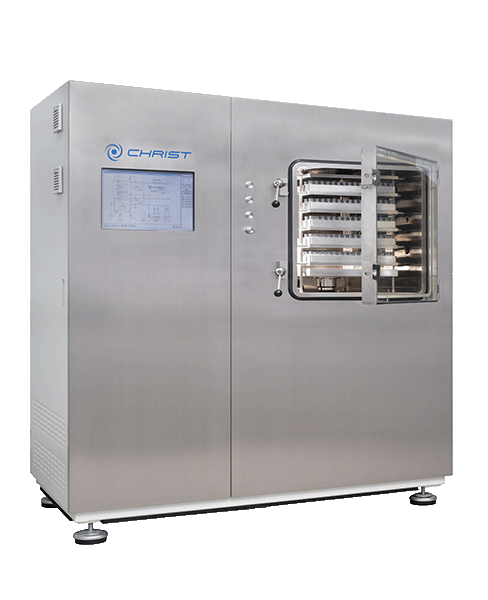
Epsilon 2-18D LSCplus
The Epsilon 2-18D LSCplus pilot freeze dryer was specially developed for the requirements of research, development, and small-scale production. With its optimized shelf space, the freeze drying system offers ideal conditions for drying nested vials and trays with protective containers such as LyoGuard or Lyoprotect.
Martin Christ's proven two-chamber principle integrates the ice condenser directly below the drying chamber. This arrangement enables optimal flow conditions for the water vapor and ensures uniform, reproducible drying with maximum process reliability.
The Epsilon 2-18D LSCplus freeze dryer can be used, for example, to dry bacterial cultures, viruses, blood plasma, serum fractions, antibodies, vaccines, drugs such as chloramphenicol, streptomycin, vitamins, biomass, and plant extracts for biochemical tests.
Technical data
| Ice condenser capacity: | 18 kg |
| Ice condenser temperature: | –75 °C |
| Shelf dimensions: | 540 × 400 mm (W × D) |
| Number of shelves: | 1 to 7 |
| Shelf area: | 0.22 m2 to 1.51 m2 |
| Shelf spacing: | 481 mm to 55 mm |
| Shelf temperature: | –60 °C to +50 °C |
| Shelf temperature accuracy: | max. ±1 °C |
| Cooling systems: | Independent systems, water cooled |
| Ice condenser cooling system: | 4 kW compressor |
| Unit dimensions: | According to customer-specific requirements (URS) |
WTMplus 2.0 – Wireless Temperature Measurement
The WTMplus 2.0 (wireless product temperature measurement system) avoids the disadvantages arising from the use of wired temperature sensors. It is significantly easier to use in practice. There is no need for temperature sensor cables or connectors inside the vacuum chamber. The wireless self-powered sensors are placed manually or automatically when the product vials or dishes are filled and report the corresponding product temperatures to the unit controller during the entire lyophilisation process.
Technical data
| Probe dimensions | Length: 21 mm plus 29 mm flexible antenna Diameter: 2.8 mm |
| Temperature measuring range | –60 °C to +135 °C |
| Measurement accuracy | ±1,0 K |
| Temperature resolution | 0.1 K |

Comparative pressure measurement
In addition to product temperature measurement and pressure rise testing, the simultaneous use of two vacuum sensors with different measuring principles can provide information about the progress of the drying process. The commonly used Pirani gauge indicates higher absolute pressures at the start of the primary drying phase because its operation is dependent on the gas type and large amounts of water vapour are released at the start of the primary drying phase. By contrast, capacitive pressure sensors are independent of the gas type. The approaching end of the primary drying phase, which occurs when there is no longer a significant concentration of water vapour, is indicated by the gradual approach of the two pressure curves to each other during the process.
Sample extraction system
The sample extraction system allows individual sample containers to be removed under vacuum during the drying process without interrupting the drying process. This is done by using a gripper arm to pick up the sample container, close it, and remove it through a vacuum lock. This allows individual sample containers or vials to be removed from the freeze dryer at defined intervals. The samples removed through the vacuum lock can be investigated and analysed in parallel with the ongoing process. This allows the progress of the process to be measured and documented in detail.
Technical data
| Sample containers/vials: | 6R to 30R Max. 50H |
| Coupling flange: | DN 160 clamp |
| Gripper working range: | 200 mm |
| Stoppering device: | Teflon-coated plunger |
| Vacuum lock: | DN50 |
| Materials: | Stainless stell 1.4404 and 1.4435, Teflon, Borosilicate glass |
| Visualisation: | Direct or with a digital camera, lighting fixture and monitor |
Glove box connection
High safety requirements are often imposed on unit operation in practice. For example, combinations of freeze dryers and glove boxes are used when freeze drying is necessary to protect products against harmful environmental factors or because the products concerned are highly active and possibly toxic. A special docking frame is used to connect the freeze dryer directly to the glove box. This isolates the entire drying chamber and the working area for product preparation from the technical surroundings.
Implementation using standard docking frames. Special versions are possible on request.
Manual and hydraulic stoppering devices
A manual or automatic stoppering device, depending on the unit type, is used to close drying containers or vials by pressing in stoppers. Electrohydraulic stoppering devices with stainless steel bellow seals are used in particular in pharmaceutical applications.
H2O2 disinfection
Sterilisation with vaporised hydrogen peroxide (VHP; H2O2) is an economical and effective alternative to pure manual disinfection using isopropanol or similar substances and steam sterilisation, which is common practice in production processes.
VHP is especially worthwhile in situations where the capital cost of installing steam sterilisation equipment is too high, but the benefits of using a reproducible process are necessary. With the VHP method, the freeze dryer is connected to a suitable VHP generator in a closed loop, usually by means of hoses and quick-release couplings, so that the VHP generator can also be as needed with other equipment.
Solvent-resistant version
Along with freeze-drying of aqueous media, freeze drying of substances containing aggressive solvents is necessary in some areas such as pharmaceutical research. All of the solvents in this connection have freezing points within the technically manageable range, such as DMSO (eutectic point +15 °C), tertiary butanol (+25.5 °C), dioxane (+12 °C) or acetonitrile (–45 °C). Freeze dryers for this application scenario are designed to be chemical resistant, which means they have modified valves and door seals, special vacuum pumps, and modified cooling systems. The particular advantages of lyophilisation compared to liquid removal by evaporation are the better structure of freeze-dried products (powdery or sponge-like, rather than a viscous mass), lower final solvent content and gentler handling.
Inertisation
Drying and ice condenser chambers are inertised by flushing them with an inert gas, such as nitrogen or argon. The air in the chambers at the start of the process, including the oxygen present in the air, is displaced by the inflowing inert gas. This method is used in particular for the drying of products containing solvents for which an inert atmosphere is required in the process chamber.

Do you have questions?